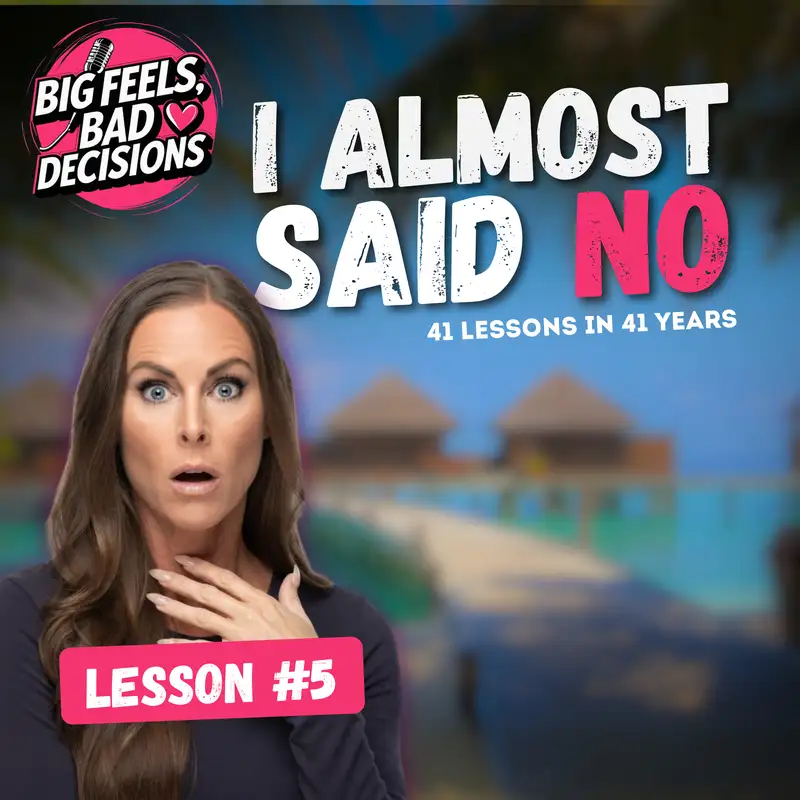
I Gave Up a Pension for an Island | Lesson 5
Don't be afraid of the unknown. Don't be afraid of the little things. If an opportunity presents itself to you in life, it's usually a gift. And if it scares you, it's probably one that you should jump on. Instead of being worried about, "Oh, what if it doesn't work out? What if this happens? What if this..." Ask yourself, "What if?" What if I'm smart enough and I'm aware enough that I will manage that uncertainty as it presents itself?
Today I'm talking about what my life was like in the Maldives, and how I got this insane opportunity to begin with.
It all started when I was working at Gahcho Kué Diamond Mine with De Beers up in the Northwest Territories. I really loved that job. I was there for almost five years. I was an environmental officer. I was on a two-and-two shift. I got to see some really incredible, beautiful, unique experiences while I was working at that property. I really loved the job. I really loved the people that I worked with. And I wasn't looking for other opportunities. I was kind of comfortable in what I was doing.
I was around 35 at the time. And I had always had this in the back of my mind: "Man, I'm 35. I still want kids. I still want a family. I still want these things in life. And these are things I'm kind of starting to look at and get more serious about." But I've always wanted to live in another country. Some of my friends spent a year abroad. Some lived in Australia. Some lived in Africa. Some went to New Zealand. And they have all of these great, unique stories about living abroad, living in another country. So I always felt like that was a piece of my life that was missing. That was something that I wanted to experience. And I didn't feel like I could really experience that if I had a family, if I had kids. I wouldn't feel comfortable moving my family with a new baby to another country and struggling through that for a year or two. So I felt like that was always in the back of my mind. That was something that I wanted. But I wasn't looking. I was happy with where I was and where I was working.
One day, I am checking my emails, and I saw that I had an email from an old professor, one of my sustainability professors, and he was recruiting for a friend of his. And the job was environmental manager in the Maldives, and it immediately had my attention. I was like, "What is this? Maldives has always been a country on my list of places to visit, for obvious reasons. It looks stunning and beautiful."
But I learned a little bit more about the Maldives through my environmental sciences program. I learned a bit about small island nations and the risk that climate change poses to countries that are two meters above sea level. And if sea level were to rise two meters, those countries would be completely underwater. And Maldives was obviously one of those nations at risk. So I always thought, "Man, if the Maldives disappear, that's somewhere I really want to see in this lifetime." I was never once thinking that this is something that would come to fruition. I never thought this was an opportunity for me.
So when I saw this post for a job in the Maldives, I was intrigued. I was like, "Oh, that's fancy." So I messaged my professor back and was like, "I'm really curious to know a little bit more about the opportunity." And he responded and was just like, "Yeah, please send a resume." And I figured, "Okay, he's probably getting bombarded with all of these questions. What is this?" Because he sent it out to the alumni, so I could imagine that there were tons of people asking questions about it. So I sent a resume.
And a couple days later, I got a message from the secretary to the GM scheduling a phone conversation. And I didn't think anything of it. I was just like, "Oh, this is really cool. They just want to explain the opportunity to me in person because he probably knows more about it."
I took the phone call, and we talked for like an hour. He's such a funny character, and he's an amazing human being. He's a great storyteller, and he was telling me all about this property that he's working at and that he's managing. He didn't have to sell me on the opportunity at all. I was already interested. I was already wanting to know, "What are the logistics? What does this look like? What are you looking for? How can I help you?"
So he's telling me all about this opportunity, and then he turns it on me, and he's like, "Okay, well, tell me what you do." I'm like, "Oh, I'm an environmental scientist. I'm helping the mine site with their terms and conditions of their licensing. I'm making sure that they're in compliance. I do all these inspections." And he cuts me off in the middle of it. He's like, "Oh, that sounds boring." He was just so uninterested. And I don't know if he was just like, "Oh, what you're doing is boring. Come work in the Maldives." But I was like, "Oh, okay."
And I just thought the conversation was great, that it was to tell me about the opportunity. But midway through, I suddenly realized, "Oh, my God, this is an interview. I'm being interviewed." And then I got nervous. I was super casual through the whole conversation, but then when I realized this was an interview, I kind of got, "Oh, oh, my goodness. Pressure, right?"
So at the end of the conversation, he's like, "Well, you sound great for the opportunity. I'm going to give you a week to think about it." And I was like, "Oh, okay. Yeah." I wasn't even thinking about the opportunity, so I wasn't thinking of questions that I would need to ask logistically, like, "How does this look? What are the steps I need to take?" I had a million questions after, but I had no idea what to ask, because it was kind of sprung on me. I really wasn't expecting to have the opportunity to begin with. But I was floored. I was like, "Okay. Thank you. Thank you for the conversation."
So I was kind of stunned when I hung up, and I was at site at the time that I took this call. So I run into my friend's office. I'm like, "I was offered the job. They offered me the job."
And if I hadn't known my professor personally, I would have thought it was a scam. Like, someone calling you from the Maldives, offering you a job to go live there and work for a couple years as, you know, environmental manager for this extremely high-end hotel chain. Like, it just sounds like a dream. But it's an opportunity that's, like, right there in front of me.
So I was thrilled, and completely beside myself that I'd been given this opportunity. I felt so lucky, but also terrified, because I was in a secure job. I had a pension. I got paid really good money, and I really enjoyed the work, and I liked where I was.
But there were some dynamics that were playing out at that mine site where I could kind of see the writing on the wall. I wasn't sure if I was going to be given opportunities of advancement, just because of some individuals that were hired and some individuals that were there, the political dynamic, I guess, of what was kind of going on around me. I felt like if an opportunity was presented to move up, that there was one individual that was going to be offered the opportunity over me because he was a better talker, and not necessarily skill or qualifications. He was just in the boys' club, and I was not.
So I felt like this opportunity, it's unreal, and I would be silly to say no. But if I took this opportunity, there's a lot of risk involved. I had just purchased a massive house in Cochrane, Alberta. It was a huge mortgage. It was a huge property. And I had a dog, and she was one or two at the time, so she wasn't very old.
And I went home and I just really thought it through, and I was like, "Okay, if I say yes to this opportunity, it could be incredible. It could be life-changing." And if I said no to this opportunity, then I stay and I do my job, I know what I'm doing, and I know what that life looks like, and I have a sense that I may not like an outcome. If there's opportunity for advancement, I could be stuck reporting to someone that I don't necessarily want to be reporting to.
So there was a risk at staying, and there were risks for taking the opportunity. And ultimately, I just thought about, "Okay, so if I say no to this opportunity, I'm going to be telling people for the rest of my life that I was given an opportunity to work in the Maldives, and I didn't take it." And I just thought to myself, "If somebody told me that, I would think they are absolutely batshit crazy. Why would you not take it?"
So I made a deal with God. I was like, "Listen, when I really narrow it down to the two things that I absolutely need to work out in order for me to feel comfortable taking this opportunity, I need someone to rent my house, and I need someone to watch my dog." And those were the two most important assets that I had in my life that I needed to make sure were taken care of, for me to feel like everything else, all the other little details, could be worked out.
So I made a deal with God. I was like, "All right, well, if I'm going to rent out my house, then I have to list it." And then I was like, "Oh, I just got home from shift. I'm tired. I had a long run, a lot of days, and I just kind of want to relax. I want to take it easy today. I'll list it on the weekend." But there was like this nagging sense in my mind, like, "Absolutely not. You have to list it right now. Just put it online and forget about it. You just have to do it now."
And if any of you have listened to a previous episode, you kind of know how this works out. But I listed my property for rent literally ten minutes later. Friends of mine who were looking to move down contacted me, and I was like, "Yeah, you know, I've had this insane opportunity. I've got to rent my place, and I've got to find someone to take care of my dog so that I can take it, and this is kind of what I'm dealing with." And they were just so chill about it. They were like, "Yeah, we'll rent your place and we'll watch your dog." And I was floored. I was like, "It can't be that easy." They were great. They sent the deposit. They signed the lease.
I packed up everything I owned from that house. I threw it in a sea can. My parents helped me move again. My parents have helped me move a couple times, to the point where I can't do that anymore. I have to hire movers if I'm ever going to move again. I moved all of my belongings out of the house. I worked out all the other details. I found out more information about my contract and what that looked like. I was set to go. I packed up what I thought I would need and headed to the Maldives. And I was off.
It was an unreal experience being in the Maldives. And I actually found out that there were quite a few people that I knew who had lived in the Maldives before, because you use float planes everywhere to get around. You have sea planes all over the place. And a lot of the Canadian water bombers do tours over in the Maldives to get experience. And I didn't really realize that. And I spent about 24 years in Yellowknife. And there's tons of float planes around Yellowknife because there's all kinds of lakes. There's lots of fishing lodges and all kinds of hunting lodges. So there were quite a few people that I knew that had lived there or spent some time there.
And I kind of got to learn about Maldives and how they get around. And I never really looked into the country that in depth, but each atoll is like a province in the Maldives. And I was living at the Raa Atoll, which is in the north, on the island Maamunagau. So I worked for the InterContinental Maldives Maamunagau Resort. And it took me a little minute to figure out how to say Maamunagau, and how to pronounce a lot of the words in Dhivehi, which is the language of Maldives, and it's a very beautiful language.
And the culture is just incredible. Everybody is so friendly. All the local Maldivians were so accommodating, so friendly, so nice. On the island, only Maldivians can be boat captains and the boat crew because they navigate the water, and it makes complete sense to hire local. And also, you want to make sure that you have professionals navigating those waters.
There were people from all over the world that worked at this property. There were people from Nepal. They were all the security. People from the Philippines. They were HR, admin roles. And I made wonderful friends from Kenya. One was in HR. One was the engineering director, and him and I were just two peas in a pod. I absolutely loved this person, and he had my back the whole time on the island.
Because as amazing as this opportunity was, it wasn't all sunshine and rainbows. I did experience some hard times. There were a couple people on the island that I feel were a little jealous of the opportunities that I was given in my role on the island, and they made a point to make my life difficult. And they did. It worked. It was a pain point, and I could feel the tension from them on the island. Whether they knew it or not, I was well aware of how they felt about me.
But I did have a core group of friends that always had my back. There were incredible scientists from the States there, and we became really good friends. They were from the ocean group and the manta group. They were studying the coral reefs and the manta populations. So they were in charge of guest experience with the mantas, but they also did research trips to study the manta ray population. There was a massive manta ray population in the Raa Atoll, and in the Baa Atoll, which is a neighbouring atoll, there is a biosphere, a wildlife sanctuary, some protected oceans. So there's lots of scientists there. There's an Olive Ridley Project that protects the sea turtles. So when there were sea turtles that we found with ghost nets attached to them, making it difficult for them to swim, the manta team and the ocean group, they would remove nets. And then if the turtles couldn't swim, or they were struggling because they were bloated from being surfaced too long, then they would go to the Olive Ridley Project for recovery. Which was really interesting to learn about, and everything.
But back to the not-so-great experiences. These individuals that were trying to make my life difficult would leave me off of email chains. So there would always be management get-togethers, and the GM was so keen on getting the management team together to get to know each other, to form relationships, to kind of bond so that all the operations can work really smoothly. So he would have like management events. I think it was like once a month. It was a priority for him to get us together and have champagne and have drinks and good food and just have a good time together, jokes, laugh. And it was so special. It was such a great initiative. I loved it, and I loved getting to know everybody.
But a couple individuals would purposely leave me off of the distribution. So everybody would get the email but me, and then I wouldn't show up to an event, and it would look like I'm snubbing the GM, because it's his initiative. It's his get-together, and I'm not showing up, so it makes it look like I'm too good to be there.
And it almost worked. I think it was Christmas Eve that this happened, and the GM had the management team and one of the residences on the property, and this residence was beautiful. It was $25,000 US a night to stay at this residence, and the GM had it set up for a management get-together. I think it was Christmas Eve. We were going to watch a movie together. There was popcorn and champagne and cocktails, and it was just a really lovely thing to do. But an email went out about it, I think the day before, and I never got it. I wasn't on the distribution, so I wasn't there.
And my friend, who always had my back, the engineering director, messaged me, and he was like, "Hey, where are you? Why aren't you here?" And I was like, "What do you mean? Where are you guys?" And he was like, "We're having a whole management team event. The GM arranged it." And I was like, "Oh, well, I didn't get the email." And he knew right away what happened. He was like, "It's okay. Don't dwell on it. Don't let that get you down. Just come. Come here. It looks bad that you're not here." And I was like, "Well, if nobody wants me there, why would I go?"
And I felt so in my head about it, and I was so upset that there were people there that disliked me so much that they wanted to do that to me and humiliate me in that way. And it hurt. It still hurts to think that people could be that mean. When I didn't do anything to these people. I was just there. And the opportunities that I had were privileges that were given to me outside of my control. So it was just jealousy, and it was kind of low, what they were doing, and it didn't make me feel very good.
So I was kind of on the fence. I'm like, "Well, I don't really want to be somewhere where nobody wants me." And he's like, "No." He's like, "We want you here. Don't worry about it. Don't worry about them." He's like, "I got you." And he was just so great. He was such a good friend to me.
So I showed up, and I was pissed. It's really hard for me to hide my emotions. My face will always call me out. And I was pissed about the incident. I knew exactly what happened, and so did they. And I walked in, and there they are, the ones who did it. But so was everybody else, and everyone else was clueless. They had no idea what was going on.
So I sat down, and I tried to enjoy myself, but I know that I have an energy about me. I know the room was off. I was pissed. I couldn't really hide it. I sat down. I was trying to enjoy myself. I got a drink right away. And I saw my friend, sat down with him.
And then the GM kind of mentioned, "Oh, you made it." I could tell he was kind of hurt that I was late. He kind of took it personally. It was kind of a snub. And I was like, "I would have been here. Nobody emailed me. I was left off the distribution." And I made a point to say exactly what happened, because there ain't no way anyone's getting away with this. So I kind of indirectly called out the person that left me off the distribution. And it was a bit of an awkward moment. And the excuse was, "Oh, I just used an old distribution list. I must have made a mistake." And I mean, this wasn't the first time that excuse was thrown. It wasn't the first time that that happened.
And I was just like, "Whatever." I did what I intended to do. I called it out, because I'm not going to sit there and be made to look like I just snubbed the GM when I wasn't aware of the little get-together to begin with.
So that was really hurtful, and it was upsetting. And that was something that kind of continued while I was there on the island. But I really didn't want this little bout of jealousy to shadow my experience on the island. I had a sense that it was a limited experience. In my mind, I thought for sure, it's a two-year contract. I'm guaranteed two years. But no one could have anticipated what COVID was about to do to really shake up that experience.
And I didn't see COVID coming, but I had a gut feeling to not worry about this petty little catty stuff that was happening in the background, and focus on my friends who I made there and the friends that had my back. Because out of all the people that were on the island that I was working with, 90% of them, 95% of them were just incredible friends to me and just incredible individuals. And just learning about their background and their experiences and their countries and their languages, it was so much. I was so grateful for the experience that the little bout of feeling left out, I really didn't want that to shadow the experience, or to get involved in that kind of political game.
I was definitely going to defend myself any time that happened again, but I could understand where some of them might have been coming from and how they would have felt. Here's this white girl from Canada that's coming to this island with no hospitality experience. My experience was in mining, and I think that upset a lot of people because they couldn't figure out how environment in mining and environment in hospitality, they couldn't see that connection. And there were a lot of them that really didn't feel like I belonged there. Including some of the higher-ups, I came to find out. Not the GM. The GM was great, he's the one that brought me there. But some people that were under him that really didn't buy into why I was there to begin with, which was interesting to find out.
But again, I didn't let that overshadow my experience and the opportunities that were in front of me.
I was given privileges. Apparently, I wore linen. The GM wanted me to kind of stand out. I was there to promote sustainability and environmental protection, and be the voice of what the resort is doing in terms of recycling and sustainability, to promote the green agenda that comes with an InterContinental property.
So I worked very closely with the engineering director to learn about all of the engineering and the reverse osmosis desalination plant for the island's water and how that worked, and all of the water recycling programs that really conserved water use on the island. And it being an island property, you know, the only way you get resources is by boat, so the shipping routines and optimizing the supply chain to reduce the environmental impact, and all kinds of things. Like, I learned so much about how they operated, and my job was to promote that side of the island.
So the GM really wanted me to stand out to guests and have those conversations with guests to promote that. So he wanted my uniform to be linen. And apparently the only person that wears linen on property was the GM. And he wanted me in linen. So a lot of people got really upset about that. That was another privilege, I guess, that I didn't realize was going to shake the boat. So it made me stand out even more and kind of rub people the wrong way, which I have no part of. I don't have control over that. I'm going to do what my boss tells me to do. And I work for him at the end of the day, and I want to make sure he's happy with my work and my performance. I don't care what I wear. Put me in linen, put me in a dress, put me in scrubs. I don't care what I wear. It really didn't matter to me. I was just doing what I was told. But that was interesting to learn about.
But at the end of the day, I knew that this opportunity was going to be short-lived. Whether it was a year or two years, whatever it ended up being. So I wanted to make the most of it and really take it all in.
So the girls that worked for Manta, and they were doing the research trips to study the manta ray population, they had research trips three times a week, and they would also have guest trips that they would take out to see the mantas and swim with the mantas. So because of my unique role on the island, I went with them a few times to see what their job was, what did they do, how were the manta populations. I wanted to learn everything that I could.
And so I went out with them a few times on the research boats, and I swam with the manta rays, and I swam with wild dolphins that just happened to be out there.
And I think the first day that I went out with them, we were up in an area where there were manta populations. We found a group of them, and we were swimming with them, and I popped my head up, and all I could hear were the guys on the boat screaming, "Whale shark! Whale shark!" They were screaming something, and I didn't really know what they were saying, but they were in a frenzy, like they were freaking out. I was like, "What's going on?" So I swam back to the boat. Everyone else stayed with the mantas, and I swam over to see what was going on at the boat, and just in that moment, they all pointed, and I looked down. This massive whale shark was right in front of me.
I've known about whale sharks. I've read about them. I've seen them. I've never been in the water with one. It very much looks like a whale, and it's got shark in the name. So it was such like a confusing experience to see one in the ocean, and the fear that went through me. Like, I was excited, and fearful, because in that moment, I was like, "Would he eat me?"
It's massive. It's this massive whale shark, and he's right in my face. And no, he didn't eat me. He didn't care. He just swam right past me, and then dove down into the deep blue. And it was such a brief moment, and I was just, I tried to get a photo. That photo was horrible. I had a little GoPro with me, and it didn't really work out. And I was just like, "Dayna, soak in this moment. Don't worry about this camera. Take this all in and remember this." And I did, and it was incredible, and it was really cool.
And I didn't realize that whale sharks in the north were so rare. And so when I got back on the boat, I was like, "Yeah, I saw a whale shark. Cool." And I didn't realize that that was going to be a moment of tension on the island for some people as well, because it's very rare to see a whale shark, and it put people off. Apparently, that I was the one that got to see a whale shark. Why was I on the research boat? Was I even doing my job? It was a thing. It shouldn't have been a thing, but it was a thing. And I didn't let it bother me. I was just like, "Whatever. People can be jealous, but I got to see a whale shark, and that's going to live with me for the rest of my life." And that was really cool. So there was that.
And then there was also a moment of, like, I was just humbled so quickly, meeting all of these different people from all of these different places that had incredible stories. Every single one of them on the island spoke more than one language. It was at least two, some of them three or four or five languages, and that was just common to them. And there's me from Canada, so everyone right away, "Oh, you speak French. I'm from France." And I'm like, "I don't speak French." I can't even say it. I can't even speak French. And they were like, "Oh, okay. Well, your English is really well." I'm like, "I should hope so. It's the only language I know."
So that was humbling, to be around all of these incredible individuals from all of these diverse backgrounds that speak multiple languages. And here I'm this ignorant Canadian that comes over and I speak one language. Thank goodness it's English, because they can all understand me. But they all speak English and their home languages and multiple other languages. I was humbled. I was like, "Okay, I feel really ignorant." And it was eye-opening. And just being around all the different cultures, it was fascinating. I really loved it. And I made some really great friendships through that experience.
So when I first got there, my GM wanted to really integrate me with hospitality, because he knew my background was in mining. And he's like, "I really need you to get the sense and the feel of what good hospitality looks like, and how we treat guests, and what guests expect from us."
So he sent me to the Six Senses property in Laamu. And that's in the south. He also sent me to the Holiday Inn in Kandooma, to check out that property and the hospitality there and the differences between the chains. Because Six Senses, Holiday Inn, and the InterContinental were all properties owned by the same individual, this rich billionaire from Singapore.
So the GM sent me to the other two properties. The Six Senses is known for their sustainability. They had a girl from the US working there as a sustainability manager. The GM really wanted me to meet her and understand what her role is at Six Senses, and bring back some of those ideas and inspiration to the InterContinental, to kind of integrate that into the operational model for our property. So that was an incredible experience. The girl that I met, the sustainability manager there, she was great. And then I went to Kandooma and learned about their sustainability practices. The team there was fantastic.
And as I was getting comfortable in my role on the island, I made good friends with the marketing and media manager. She was hosting one of the reporters from Robb Report Malaysia on the island. And she thought it would be great to introduce me, and for the reporter to have a little piece on the InterContinental sustainability initiatives. So we went for dinner at the Lighthouse, which is like one of the fancy restaurants on the island. And it was just a casual conversation. It was my first experience in media. She eventually wrote up an article on sustainability and had me featured in it. I was featured in the Robb Report February edition, 2020. And that was wild. My name is in Robb Report. That opportunity was surreal.
That was my first experience in media. And I got a little bit more involved. There was another guest that was staying, and she interviewed me, and that interview was partnered with Amazon and Netflix. And that experience in media kind of sparked an interest. It sparked this little thought in my mind of how much I loved doing that. And I can't help but compare and contrast that experience, and I enjoyed that too, with what I'm pursuing now with my podcast venture and media in general. So that's kind of a funny little reflecting moment for me.
On the island, the GM also started an initiative: Management Cocktail Fridays. And you guys, this was my absolute favourite thing on the island. This was my favourite thing to do. You would meet every Friday, as long as you were not in uniform, you'd meet at five o'clock at one of the outlets. And you could have cocktails with the guests. So the purpose of Management Cocktail was for the guests to meet the management team and talk about resort initiatives. What do we do on the island? What are we doing? How are they enjoying their stay? Do they have any concerns or questions? Or just a chance to mix and mingle with the guests.
And this was my absolute Super Bowl. Like, this was so much fun for me. One, I got to drink champagne on a Friday at work. And two, me and my buddy, the engineering director, would team up and just chat with the guests and get to know these incredible individuals that are travelling to InterContinentals around the world, or just different properties around the world on their vacations. And because he was the engineering director, he would have all of the technical details around our sustainability initiatives. And I would come in with the environmentally friendly, like, wildlife initiatives and, like, the fuzzy environmental stories. And that was my favourite thing. I got to talk about something that I'm passionate about with amazing people from all over the world. And I got to drink champagne every Friday. So that was one of my favourite things to do on the island while I was there. And I got to meet so many different people.
And that was also another moment that kind of sparked how much I enjoyed having conversations with people. And when I was thinking of the podcast and thinking of interviewing people and hearing their stories, it kind of brought me back to Management Cocktail and how much I enjoyed doing that, and kind of thinking how I could incorporate that into this new venture that I'm embarking on. So that definitely spurred some inspiration into what I'm doing now. A highlight of my experience in Maldives, for sure.
And there were just so many other cool things that I was able to be a part of. And one of them was fishing. There were fishing boats every couple of weeks. I caught a grouper. We saw mantas.
The GM arranged a management outing, and it was on the yacht, and it was a sunset dolphin cruise. So he had a whole tub of champagne and cocktails and drinks and snacks on the yacht for us. And we were all there as a team having drinks and doing a sunset dolphin cruise. And I just had this moment of, like, "Is this my life? What did I do in a past life to have this blessing right now?" With these incredible people, including the ones that were a little bit jealous. They were fine. I still enjoyed their company. I enjoyed everybody's company, and I really loved the people on the island. And our management get-togethers were so much fun. I really loved those, and I loved Management Cocktail.
And as a manager on the island, you get certain privileges. I had an account where I could eat at the outlets for X amount of dollars each month. I had, like, an allocated fund. So that was really fun. And I had privileges in stores, so every week you could make an order through stores. And if it was alcohol, they would just take it off your paycheck kind of thing. If it was snacks, you were allowed X amount of snacks per week from stores. So I would put in my stores orders.
And yeah, I got to drink gin, and Savannas. Savanna is a cider from South Africa that I'm absolutely obsessed with. And you used to be able to get them in Canada, and now suddenly you can't. I've been searching for it for years, and I can't find it anywhere. You can find it in the States. You can order it somewhere in the States, but I don't have it in Canada. And one of these days, I'm going to find it again, because I really love that cider and I was so excited to find it in Maldives.
Their Pringles are different. A different texture altogether. They're great. And I got addicted to the barbecue Pringles over there, but they definitely taste different.
And then there were just so many activities. I learned how to play tennis. So one of my dear friends from Kenya, she is like a tennis pro. She was so good. She taught me how to play tennis. We had this big, beautiful tennis court, and I played out there.
So I'm deeply grateful that I said yes to that opportunity. And it was an opportunity for growth, for sure.
And when COVID happened, it really rocked the boat. There was a ton of uncertainty here. I thought, well, if there's a global pandemic, the safest place for me to be would be on the island, so I'm going to stay right here. But my GM was looking out for me, and he was like, "Dayna, you're going to go home. I need you to go back to Canada, because I need you to get to Canada." I was really so naive. I didn't get how massive this COVID situation was going to be. Ultimately, I did come back to Canada.
But first, before COVID really got crazy, and it was kind of just a whisper, the GM was really worried about how he was going to manage everybody's hours and holidays, you know, if we did have to shut down. Worst case scenario, how is he going to manage everybody's time? So he wanted us all to take all of our holidays. And I was hesitant, because I did not accrue any holidays. I had only been there for a short time, and I was just at Six Senses, I was just at Kandooma. I hadn't spent a whole lot of time at InterContinental, and I was just getting in the groove of my new job and taking interviews and working with the media team, and I was kind of just getting comfortable. But he really wanted me to use up some holidays.
So I was like, okay, well, I'll go to Thailand for a few days. So he knew the GM at the InterContinental in Phuket. So I got to stay at the InterContinental Phuket for like a hundred bucks a night. And this property is gorgeous. It is a stunning property. I was just beside myself when I had the opportunity to stay there.
So I travelled to Thailand. I was in Bangkok. It is surprisingly easy to get around in Bangkok. The transit, I navigated it pretty easily. There's a colleague that I had worked with that was in Thailand at the time, kind of staying there. So I met up with him. We had a few drinks, and I went to Phuket. I stayed a few nights at the InterContinental there. And then I stayed at an Airbnb. I went to an elephant sanctuary. I almost went to a full moon party. It was always on my list of things to do. I always wanted to go to a full moon party, but then I was like, "Dayna, what are you doing? You're like 36 years old. You're not going to a full moon party. You won't even be able to stay awake." And yeah, I didn't end up going. I was also very tired from all of the travel, and I was like, no, we'll do the elephant sanctuary and, like, we'll call it a night.
And then I flew back to the island. And when I got back, then COVID really kind of blew up. Like, Maldives was starting to shut down. Like, the entire island was shutting down. And I was working with HR to get a flight, and I was telling them kind of the airlines that I have to be on to get back home. And they were having a nightmare coordinating my travel, because every time they had me on a flight, they would have to change the flight because one of the connections was dropped, and this was happening like by the hour. So it was actually starting to get a little risky, and people were starting different groups for catching different flights to go home, and everybody was leaving at different times. So it was kind of like this sad farewell to everybody. Like, I think it was a skeleton crew that stayed on the island just to keep it operating, but basically everybody was going home. Everyone was getting sent somewhere.
I was able to get on the last flight out of Maldives, the very last one, on Qatar Airways. And I flew to Doha, and I had a 12-hour delay in Doha, and I was connecting Air Canada to Montreal, Montreal to Calgary, Calgary to Cranbrook, where I am now. Air Canada was dropping connections left, right and centre. Like, nothing was certain. So when I landed in Doha, I was terrified that my connection from Doha to Montreal was going to get cancelled.
And I was working with the Canadian embassy out of Sri Lanka, because there is no Canadian embassy in Malé, in Maldives, in like the entire country. The closest one is in Sri Lanka. So I was working with them to try to see if I can get home if the worst case scenario were to happen. And they were like, "You're on your own. Like, your country is not doing anything to get you home. So get yourself home." And I'm like, okay, good to know. Like, they gave me a few airlines that were operating, like some options of flights, but that wasn't really helpful, because those connections were dropped within hours of them giving me those options. And that's fine. The HR team on the island was really helpful and got me on flights that I needed to get on.
So I landed in Doha and I was terrified of that connection dropping, but I was lucky, it did not drop. And all I could think of is, okay, well, if my connection drops when I'm in Montreal, then I don't care. I'll bus it. I'll hitchhike all the way home. Like, at least I'm in my country. The connection didn't drop. I made it to Calgary. It's a four-hour drive from Calgary to where I needed to go. So worst case scenario, I could rent a car or something and get myself home. But I caught the flight. I landed at home. I think it was midnight, one o'clock in the morning, on my dad's birthday. So he was happy to have me home.
It was chaotic getting home. COVID was, like, full blown at this point. I think it was March 2020 at the time. And I was kind of on a garden leave. What that meant was I'm still getting paid, and make about 70% of my salary. And I'm not expected to do a lot of work because I'm not there, but I was still doing work. Like, I was still promoting the resort. I was doing media interviews. I was chatting with people, obviously not working very hard because there's so much uncertainty about what's going on. But I was hunkered down in Canada.
I got an opportunity to work at one of the mines kind of at the same time. And it was just good timing for me to kind of exit and stay at home in Canada and start working with the mines again. It was the right financial decision. And there was so much uncertainty with what was happening in Maldives. My GM wasn't even there at the end of it. He moved on to another opportunity. Most of the people that I had been working with moved on to other opportunities during that time. So it was just luck. Everything just kind of aligned at the right place at the right time. And it was kind of a seamless integration of leaving that opportunity and being at home and starting a new opportunity in a new space. And it all kind of worked out in perfect timing.
I was very sad and reluctant, because I did think I was going back to Maldives, but I think that opportunity ended at the right time in my life. And I'm so deeply grateful that I had that experience to begin with. It taught me so many life lessons. I had an incredible time. I met the most amazing people, and my friends are all over the world now. I'm excited to reach out to a few of them and get some of them in on this project that I'm working on in the near future.
And it was just all around such an amazing experience that I never would have had if I let the fear take over.
And so the lesson that I took away the most from this opportunity was: don't be afraid of the unknown. Don't be afraid of the little things. If an opportunity presents itself to you in life, it's usually a gift. And if it scares you, it's probably one that you should jump on. It's probably one that's going to lead to growth and expansion and excitement in your life. And new opportunities should scare you a little bit, but you don't have to be afraid of them. Fear should never hold you back from an opportunity.
I recognized that if I let myself sink into the fear and let the fear take over, and just not take the opportunity because I was so fearful, I would have regretted that for the rest of my life. And not just because people would think I was crazy for not taking an opportunity to live in the Maldives, but I knew what I was missing. I knew what I would have been missing.
And if an opportunity presents itself, ask yourself, "What if?" Instead of being worried about, "What if it doesn't work out? What if this happens? What if this happens?" Ask yourself, "What if it all works out? What if I'm smart enough and I'm aware enough that I will manage that uncertainty as it presents itself?"
There is a solution to every problem. And even in the worst case, you can probably sort out a solution. If there's something that comes up that's really unfavourable, or something unexpected, then deal with it in that moment. Don't give in to the fear and the uncertainty of the unknown.
Were there situations that arose that could have been absolutely horrific? Yes. COVID happened, and it disrupted that entire opportunity for me. My two-year contract ended up being just basically six months. And that's a quarter of the time that I was anticipating having there. I was just getting comfortable. So there's a ton of uncertainty. There's a ton of risk. And I didn't know a global pandemic was going to come out of nowhere in the middle of that opportunity.
But I'm still incredibly grateful that I took that opportunity, because in the little time that I had there, I learned so much about other cultures. I met amazing individuals. I made connections for life, and I had such an incredible experience that that outweighs anything negative that I experienced.
And it really did lead me to jump in on what I'm doing today. Because when I reflect on that experience, I had such a positive experience with media, and with those interviews, and with talking with guests and getting to know their stories. I had such a great time doing that, that I want to start this new venture with that in mind and bring that into this new project that I'm working on. And that's what I'm going to do moving forward. So had I not said yes to that opportunity, I never would have realized how much I really enjoy that media and that space, and this whole field.
So with that, I hope you enjoyed the story of me living abroad in the Maldives. And if you liked listening, feel free to like, share, subscribe, and follow along for more.